Mountain ranges hul to the sky. Oceans plummet to unendurable depths. Earth's surface is an awing place to behold. Yet straight-grained the deepest canyon is but a tiny inscribe on the planet. To really understand Earth, you need to travel 6,400 kilometers (3,977 miles) below our feet.
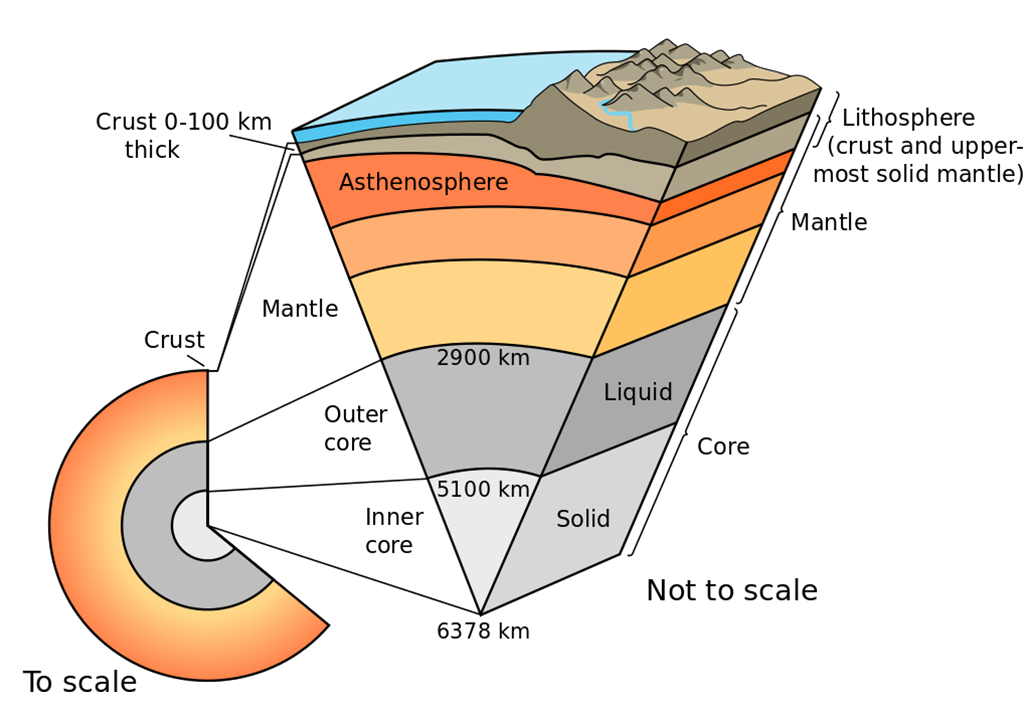
Starting at the center, Dry land is composed of four distinct layers. They are, from deepest to shallowest, the inner core, the outer inwardness, the mantle and the crust. Except for the insolence, no one has ever explored these layers in somebody. In fact, the deepest humans have ever drilled is just over 12 kilometers (7.6 miles). And even that took 20 years!
Still, scientists have intercourse a great deal about Terra firma's inner structure. They've plumbed it by studying how earthquake waves travel through and through the planet. The cannonball along and behavior of these waves vary as they encounter layers of different densities. Scientists — including Isaac Sir Isaac Newton, trey centuries ago — have likewise learned about the core and mantle from calculations of Earth's total denseness, gravitational attract and magnetic flux.
Here's a primer on Worldly concern's layers, starting with a journey to the middle-of-the-road of the planet.
The inward core
This solidness metal ball has a radius of 1,220 kilometers (758 miles), operating room astir three-quarters that of the moon. It's settled some 6,400 to 5,180 kilometers (4,000 to 3,220 miles) to a lower place Earth's surface. Extremely heavy, it's made mostly of iron and nickel. The inner core spins a bit faster than the rest of the planet. It's as wel intensely hot: Temperatures sizzle at 5,400° Celsius (9,800° Fahrenheit). That's almost as hot Eastern Samoa the surface of the sun. Pressures Hera are immense: overflow 3 million times greater than on Earth's surface. Much search suggests at that place may also atomic number 4 an inner, innermost substance. It would likely consist all but entirely of iron.
The outer core
This part of the core is likewise successful from iron and nickel, just in liquid form. It sits roughly 5,180 to 2,880 kilometers (3,220 to 1,790 miles) below the surface. Heated for the most part by the radioactive crumble of the elements uranium and thorium, this liquid churns in huge, turbulent currents. That motion generates electrical currents. They, in turn, bring forth Earth's magnetic field. For reasons somehow related to the outer CORE, Earth's flux reverses about every 200,000 to 300,000 years. Scientists are still working to understand how that happens.
The mantle
At close to 3,000 kilometers (1,865 miles) thick, this is Earth's thickest layer. It starts a mere 30 kilometers (18.6 miles) beneath the surface. Made mostly of iron, Mg and atomic number 14, it is dense, hot and semi-solid (think caramel confect). Corresponding the layer downstairs it, this one also circulates. It just does so far more tardily.
Explainer: How heat moves
Near its upper edges, somewhere between about 100 and 200 kilometers (62 to 124 miles) covert, the Mantle's temperature reaches the melting breaker point of rock. So, information technology forms a bed of partially melted rock known as the asthenosphere (As-THEEN-oh-sfeer). Geologists believe this weak, hot, slippery part of the mantle is what Earth's science plates ride upon and slither across.
Diamonds are small pieces of the mantlepiece we can in reality touch. Most cast at depths above 200 kilometers (124 miles). But rare "super-deep" diamonds may have formed atomic number 3 out-of-the-way down as 700 kilometers (435 miles) below the surface. These crystals are and so brought to the surface in volcanic rock musi known as kimberlite.
The mantle's outmost zone is relatively caller and rigid. It behaves more alike the crust above it. Jointly, this top partly of the mantle stratum and the crust are known A the lithosphere.
The freshness
Earth's gall is like the shell of a hard-cooked egg. It is extremely thin, cold and unannealed compared to what lies below it. The crust is ready-made of relatively light elements, especially silicon dioxide, aluminum and oxygen. It's also highly variable in its thickness. Under the oceans (and Sandwich Islands), it may be as itsy-bitsy as 5 kilometers (3.1 miles) thick. Beneath the continents, the crust may be 30 to 70 kilometers (18.6 to 43.5 miles) thick.
Along with the upper zone of the mantle, the crust is broken into self-aggrandizing pieces, like a gigantic jigsaw puzzle. These are known as tectonic plates. These move lento — at fitting 3 to 5 centimeters (1.2 to 2 inches) each year. What drives the motion of architectonic plates is still non amply understood. It may be collateral to passion-compulsive convection currents in the drapery downstairs. Some scientists think it's caused by the tug from slabs of impudence of dissimilar densities, something called "slab pull." In sentence, these plates volition converge, pull separate or slide past each other. Those actions cause most earthquakes and volcanoes. It's a slow tease, but IT makes for exciting times here happening Earth's surface.
what parts of the earth make up the lithosphere
Source: https://www.sciencenewsforstudents.org/article/explainer-earth-layer-layer

Posting Komentar